Need to settle an argument? Recently, I finished coding up this Rock Paper Scissors game that you can play online against someone else. Have fun.

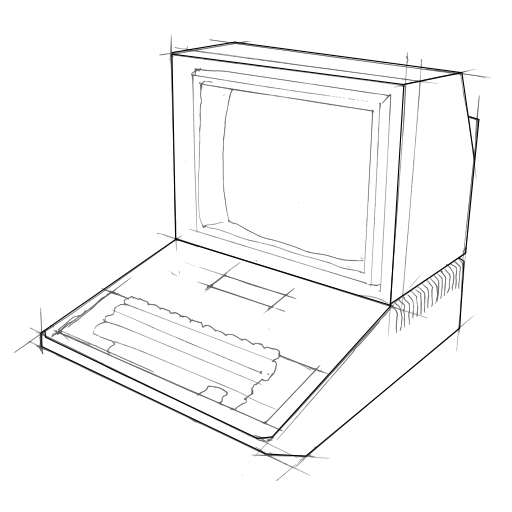
Need to settle an argument? Recently, I finished coding up this Rock Paper Scissors game that you can play online against someone else. Have fun.

Last night I put the finishing touches on an RjDj scene that I've been working on in my spare time called GhostWave. It's a dark algorithmic drum & bass generator which lets you hum the bass lines. If you have the latest version of the RjDj single (free!) installed on your iPhone or iPod Touch, you can simply visit this page from safari on the phone and click the following link with your finger:
By itself it does very little but make randomly raw semi-melodic noise. Shake it quite hard a few times to start some hi-hats tickering, and then hum a bass line into the mic. To record and loop your hummed bassline, put your finger on the little ghost as you hum your melody in time to the hats. Let go when you're done and the melody should loop. Once you're done, shake it vigorously a few more times to bring in the beat. After listening for a while the beats will fade, but you can bring them back by shaking some more, and you can continue to press the little ghost to record more melody loops.
Have fun!
Today I finished reading A field guide to genetic programming, a free, self published, creative commons licensed computer science book written by practitioners in the art of evolving computer programs. I say art because as the book makes clear this science is still quite young and experimental, mostly based on heuristics and rules of thumb. This is exactly what makes the book so valuable a resource. Outside the basic evolutionary algorithm the number of different ways of representing candidates, eliminating the unfit, reproducing new candidates, choosing population size, choosing mutation rate, etc. etc. make it incredibly complex to form a systematic analysis of the different aspects of the technique. The book gives experienced advice about all of these aspects and also suggests areas that need further study.
The book is ideal for people who want to get up to speed with the front line of current developments in the field. By the end of the book one is armed with enough knowledge to dive right in and start creating and using programs that evolve programs. A basic understanding of computer science concepts are all that is needed to grasp the concepts in the book, so anyone with a first year level of a computer science degree, or a few years of programming experience, should have no problem.
I purchased a hardcopy version of the book for easy reading and it came as a paper-back the size of a sheet of A5. The illustrations on the outside of the cover and througout the book lend it a lighthearted and easily comprehensible air and the writing itself is more enthusiastic than you would expect from a scientific text, making it an easy read. The examples provided are consice, easy to understand, and directly to the point, and the book is incredibly well referenced providing numerous texts to follow up some concepts in more detail.
Perhaps the most compelling feature of the book is the multitude of successful, practical applications of GP to real world problems which are found throughout it's pages. Before I read it, I was already convinced that the only way that we will evolve human equivalent intelligence will be through some type of artificial evolutionary process. Now I am even more convinced of that. Here are some choice quotes from the late Alan Turing, as always, far ahead of his time:
"There is the genetical or evolutionary search by which a combination of genes is looked for, the criterion being the survival value."
("Intelligent Machinery", Turing, 1948)
"We cannot expect to find a good child-machine at the first attempt. One must experiment with teaching one such machine and see how well it learns. One can then try another and see if it is better or worse. There is an obvious connection between this process and evolution.
'Structure of the child machine' = Hereditary material
'Changes of the child machine' = Mutation
'Natural selection' = Judgement of the experimenter"
("Computing Machinery and Intelligence", Turing, 1950)
What higher computer science accolade is there than Alan Turing's posthumous recommendation? In short, great book. Find out more at the official website and purchase it online at lulu.com.
I've been re-visiting some code I wrote quite a while ago which generates a virtually infinite number of generic 2D RPG maps, with grass, sand, road, trees, and water, like this:
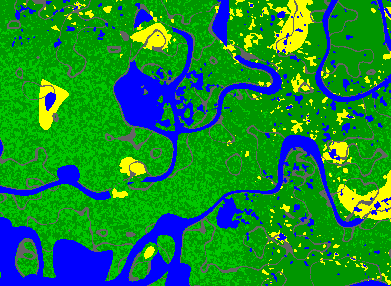
Here's the algorithm I have used, implemented in Python, using a Perlin Noise generator:
detail = abs(perlin.Noise2D(x / 300.0, y / 300.0))
desert1 = -perlin.Noise2D(x / 100.0, y / 100.0)
desert2 = perlin.Noise2D(x / 10.0, y / 10.0)
desertp = desert1 * detail + desert2 * (1.0 - detail)
waterp = perlin.Noise2D(x / 150.0, y / 150.0)
roadsp = (abs(perlin.Noise2D(x / 50.0, y / 50.0)))
treep = max(0, perlin.Noise2D(x / 300.0, y / 300.0)) + perlin.Noise2D(x / 3.0, y / 3.0)

oasis = desertp > 0.95
lake = desertp < -0.6
river = desert1 < 0.6 and abs(waterp) < 0.075
desert = desertp > 0.6 and desertp < 1.0 or desert1 > 0.8
roads = abs(roadsp) < 0.05
riversideRoads = desertp < 0.6 and abs(waterp) < 0.11 and abs(waterp > 0.08)
trees = treep > 1.15

if lake or river or oasis:
    DrawWater(x, y)
elif roads or riversideRoads:
    DrawRoad(x, y)
elif desert:
    DrawDesert(x, y)
elif trees:
    DrawGrass(x, y)
    DrawTrees(x, y)
else:
    DrawGrass(x, y)
One problem is that I couldn't find a decent perlin noise generator for Python that was easy to install, so I had to roll my own, and it's dog slow (apologies to any dogs who are reading this). I even tried re-implementing it as a Python extension in C but it was still only twice as fast. Psyco also did nothing to help the situation, which basically means it isn't slow because of bad optimisation but because the algorithm is very CPU intensive. The good news is that a few nights ago, while I couldn't sleep, I think I came up with a really quick way of generating random fractal based landscapes by caching the results of previous, higher order position lookups. If I'm right, it kind of turns the Perlin algorithm inside out to prevent redundant calculations. Of course, it will trade off speed for higher memory usage, but that's ok in this situation. I haven't tested my idea out yet, but hopefully I will get around to it and make my map algorithm much faster.
Another problem is that my existing maps won't wrap onto a torus without discontinuities, which means you have to have infinitely large maps for people to explore, which go on and on forever. I'd rather the maps wrapped so I could wrap them around planets and stuff. Fortunately, I think that with the judicious use of modulus operators my new algorithm should wrap pretty nicely.
I came up with these vector art characters which I think would be suitable for a 2D RPG style game.
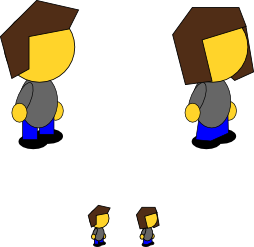
They're SVGs made in Inkscape, which is highly scriptable, so I am thinking about prototyping a character creator screen which will allow you to deck them out in different colours, clothes, accessories, etcetera, and then use Inkscape to render variations in the background.
Tingangong is the onomatopoeic name for a game design that has been brewing in my head for the last few weeks since just before we left Australia. It's actually more of a non-game, or sound toy, or art game than a regular video game, but hopefully it'd still be a lot of fun to play.
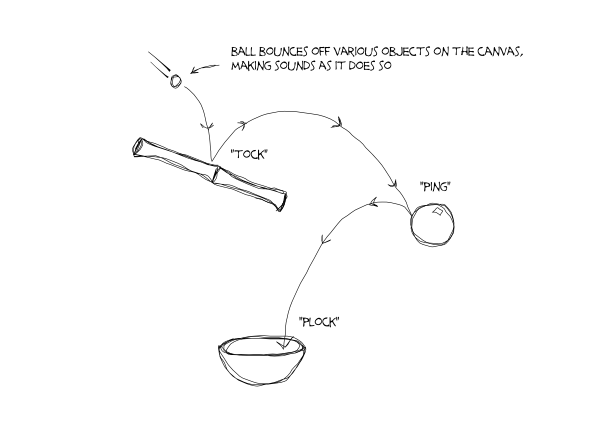
It can be summed up as a cross between the fish-and-leaves toy in Electroplankton, Crayon Physics, and The Incredible Machine. The idea is that users of the game can make "composition sculptures" by dragging various elements, each of which make a unique type of sound, onto the canvas. The sounds that each element make are triggered by tiny pinballs which are shot from cannons and bounce off the elements. Complex sculpture compositions can be set up where the balls bounce from element to element creating chains of different sounds, even music.
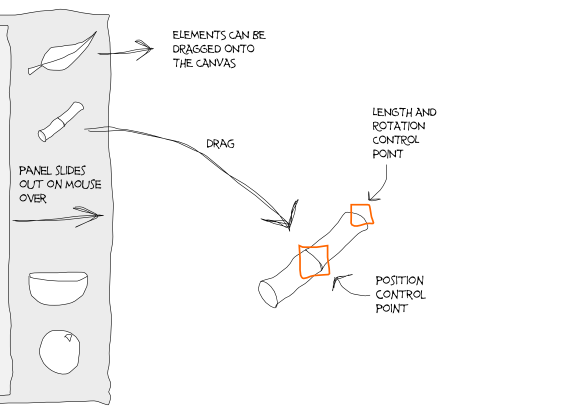
The user interface is pretty self explanatory. Mousing over the strip down the left hand side causes the panel to slide out, and then elements can be dragged off the panel and onto the canvas. There is no separate run mode vs. edit mode; the game is always running and as soon as a cannon is dragged onto the surface it will start shooting little pinballs. When the user does a mouse-over on elements that are on the canvas the control point squares appear. Clicking and dragging control points allows the user to edit the parameters of each element. For example, the piece of bamboo can be rotated, and it's length and position changed. As it is made longer the "tock" sound that the bamboo makes will become deeper. You could place several pieces of bamboo in the path of the pinball, each of varying length to create a sequence of different notes.
Ideally the canvas part of the UI would be vector graphics and hence zoomable so that you could focus in on the parts of the sculpture that you are working on, and then zoom out to see the whole thing working like clockwork. Maybe there could be a "follow ball" mode when you click on a passing pinball.
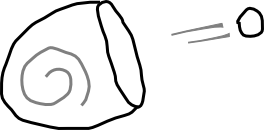
The cannon is the start of every composition as it is where the pinballs originate from. Control points allow the user to modify the position, direction and power (size) of the cannon. An additional control point allows you to change the length of the spiral at the centre of the cannon, which sets the speed at which pinballs are shot out of the cannon. This corresponds to the basic tempo of a piece of music. Different cannons can have different tempos of course.
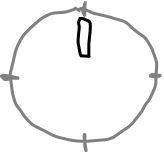
The clock has a hand which ticks with the same frequency as the nearest cannon to it. There should be some kind of visual feedback to show the user which cannon the clock is associated with. Pinballs bounce off the hand of the clock and this allows you to create pieces where pinballs go in multiple directions at different times. The clock features control points for changing the length of the hand, the position and rotation of the clock, and the number of stops on the clock's face. It might be a good idea to try having a separate spiral to control the tempo of the clock independently of any cannon. Testing will reveal which method is more intuitive and useful.
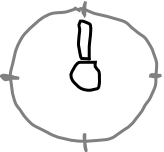
The hit clock is just like the clock, except that it only 'ticks' when a pinball strikes the centre circle. Other than that it has pretty much the same control points for size, rotation, position, and number of stops. This allows you to create more complex pieces where a ball can strike a hit-clock after a long sequence to change the direction and flow of other pinballs.

The leaf is inspired by the leaves in the Electroplankton fish-and-leaves game - it makes a plucked string sound when the stem of the leaf is struck by a pinball. The control points on the leaf allow you to change the length, rotation and position of the leaf. The length of the leaf changes the taughtness, or pitch of the string. The sound for the leaf should vary in a procedural way if it has multiple excitations in rapid succession, which goes the same for the following audible elements. An algorithm such as the Karplus-strong algorithm would work well for the the leaf, and is faily easily implemented.

The bowl contains water and makes a 'plock' sound when pinballs fall into it, and a gongish sound when struck on the sides. The bowl's position, width, and height can be changed with control points. It's width corresponds to the pitch of the 'plock' sound, and the height determines how much reverb to put on the sound. Both the width and the height determine the pitch of the gong sound that the sides of the bowl make; each might determine the pitch of one of two oscillators which are ring-modulated together.

The bamboo makes a 'tock' sound when struck by a pinball and has control points for position, rotation, width, and length. The length of the piece of bamboo determines the pitch of the tock sound, and the width determines the depth, or length of the sound.
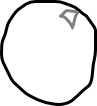
The sphere makes a 'ting' sound like a single bar from a wind chime. The control points allow you to modify the position and size of the sphere, with the size corresponding to the pitch of the chime.
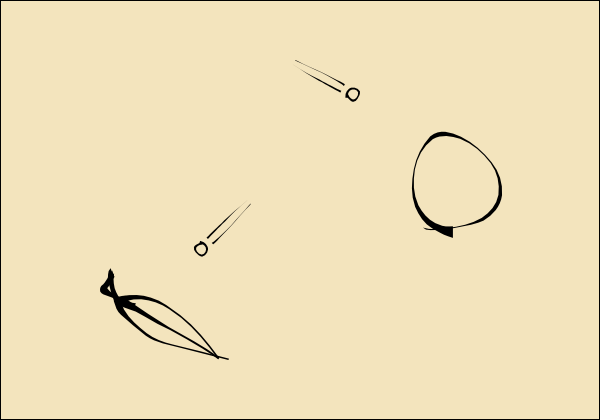
In my head the game looks like a piece of traditional japanese calligraphy (above is my pretty lame attempt at that look) and the scupltures are tinkly pretty things which sound like gamelan music, or John Cage's "Six Marimbas". I can imagine users creating fully fledged pieces with multiple parts and movements which sound as fascinating and wonderful as they look.
If I was to code up this game or a prototype thereof tommorrow (it could happen!), I would use the following combination of technologies:
All these technologies can be googled for more info.
Some good community features such as uploading and sharing sculpture compositions would be nice, and png-embedded data files could be cool as well, so that images could be dragged from a browser into the game and loaded up instantly, and users could easily share compositions by sharing screenshots. Another cool feature might be to have elements that are touching eachother on the canvas have some kind of audio interplay such as ring-modulation between the two sounds. That kind of stuff should be experimented with after the basic prototype of the game is up and running.