Jan. 6, 2021

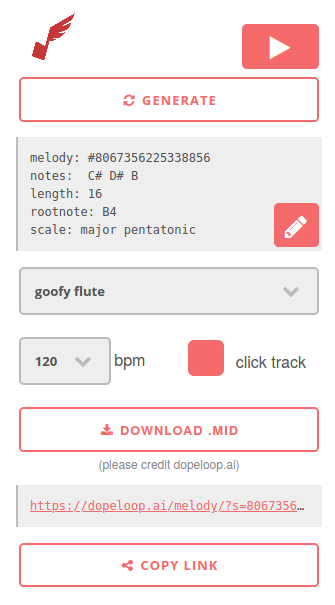
I've just released a melody generator that I've been working on for a while. It's a small web app that you can use to procedurally generate looping MIDI melodies and then use them in your own music.

The fractalesque algorithm it uses to generate melodies is one I came up with when I was writing a lot of algorave music a decade ago. The MIDI melodies are rendered to sound using the wasm port of Timidity by Feross.

Enjoy!

June 7, 2019

setup-thumbnail.jpg

Yesterday I released Hacksilver, an album of procedurally generated "algorave" music. Some people had questions about the technology used to write it so I thought I'd write this up.

The beats and melodies were generated using drillbit, a LISP codebase written in a Python variant called Hy. The project outputs Impulse Tracker mod files which are then played and mixed live.

The interesting parts of that codebase are in the generators folder. For example the drill-n-bass choppage generator is here.

Each generator has three functions:

  • make-sample-set: which generates IT wav tables that are used by the generator (e.g. individual drum kit or synth sounds)
  • make-pattern-settings: which sets up parameters & context that will be re-used by the pattern generator to provide similarity across pattern variations
  • make-pattern: which outputs the pattern data in a format easily consumed by the Impulse Tracker file writer

Mixing and live-effects are performed in Pure Data. Originally I was using a fully software based mixer. However I discovered that a nicer mode of operation is to have individual bits of sound generating/filter hardware chained together. So I started using this Raspberry Pi based mixer + FX unit from another project to mix live.

One other bit of software in there is jsfxr which is wrapped by the LISP code and outputs 8-bit synth sounds (which are then used by the pattern generator). Because the synth definitions are simple JSON hash maps there is a fun pseudo-evolutionary technique I was able to use where you interpolate between the values of two synth definitions to generate new sounds based on two synth definitions that you like.
Hardhat tracker module 
player

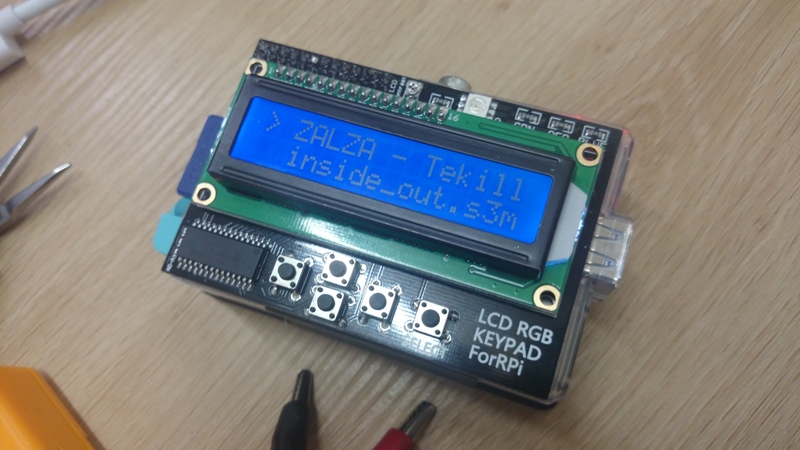
I also built a little hardware Impulse Tracker renderer based on a Raspberry Pi running XMP with my friend Dimity. It has a Pocket Operator style sync output and runs directly into the mixer that both share the same timing and the fx can be quantised to the music which is playing.

If you're interested in the music hardware that Dimity and I are building and selling you can stay updated at bzzt.studio.

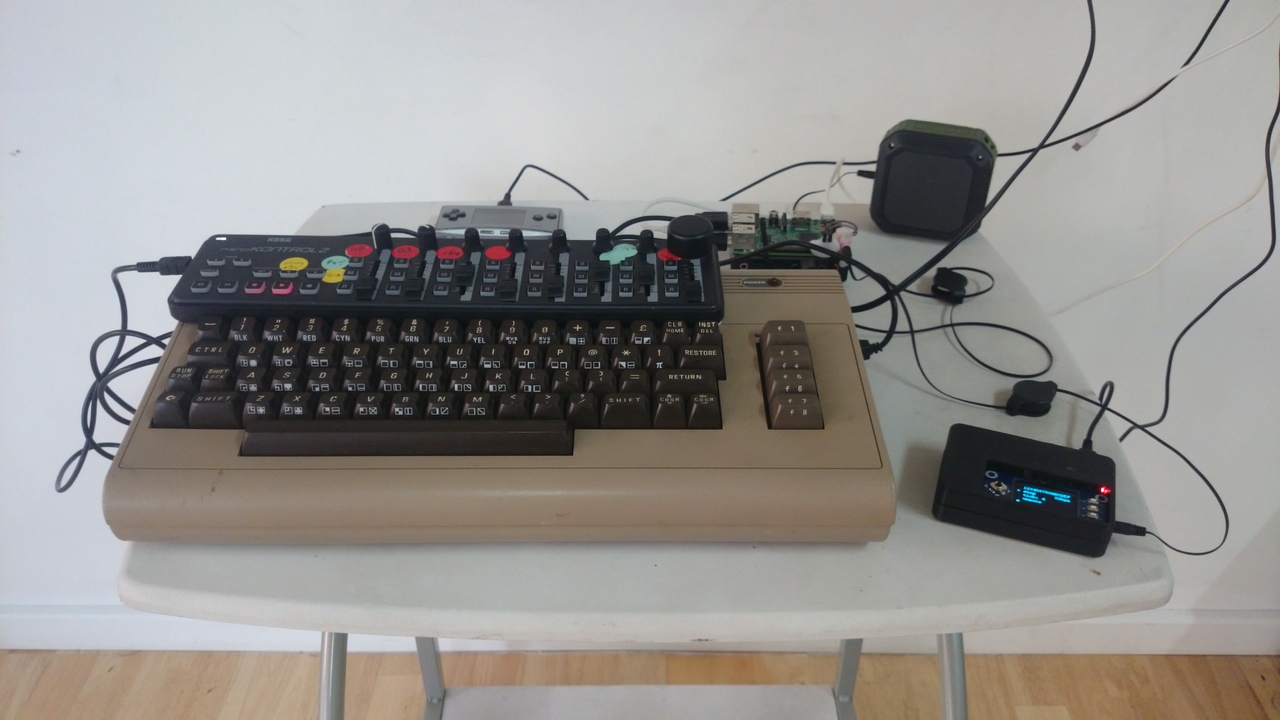
In the image at the top of this post the hardware Impulse Tracker renderer is the little box on the right hand side. The RPi mixer/fx unit is to the top right of the C64 keyboard. The Korg Nanokontrol2 strapped to the C64 keyboard is controlling the fx and mixing parameters on the RPi. They keyboard itself was for playing live synth sounds (a very simple arpeggiating subtractive synthesizer built in Pd).
June 6, 2019

I just released Hacksilver, a new album of procedurally generated music.

It uses a whole slew of weird tech to generate the beats, melodies, synth sounds including beat-generating LISP, 8-bit synth generating Javascript, and Pure Data for the mixing and mastering. One thing that was particularly fun was procedurally generating Impulse Tracker files.

Would appreciate a re-share if you know of anybody who might be into this type of thing.

Enjoy!

Aug. 3, 2018

Speccy is a small utililty I built for live-coding chiptune music in the browser with Clojurescript.

You can copy sounds from sfxr.me and paste them in as synth definitions, using code to modify any parameter over time, or start from scratch by building a synth up from basic parameters.

You can paste the following examples into the online editor to try it out:

; blippy synth
(sfxr {:wave :square :env/decay 0.1 :note #(at % 32 {0 24 3 29 7 60 12 52 19 29 28 52})})

; donk bass
(sfxr "1111128F2i1nMgXwxZ1HMniZX45ZzoZaM9WBtcQMiZDBbD7rvq6mBCATySSmW7xJabfyy9xfh2aeeB1JPr4b7vKfXcZDbWJ7aMPbg45gBKUxMijaTNnvb2pw"
      {:note #(or
        (at % 57
          {5 35
           27 34})
        (at % 32
           {0 24
            6 29
            18 21
            26 12}))})

; hi hat
(sfxr {:wave :noise
       :env/sustain 0.05
       :env/decay 0.05
       :vol #(sq % [0.3 0.1 0.2 0.1])})

; snare
(sfxr "7BMHBGCKUHWi1mbucW62sVAYvTeotkd4qSZKy91kof8rASWsAx1ioV4EjrXb9AHhuKEprWr2D4u4YHJpYEzWrJd8iitvr23br2DCGu7zMqFmPyoSFtUEqiM64"
      {:note 36
       :vol #(at % 16
         {4 0.5
          12 0.5})})

The full source code and documentation is available at GitHub.

Enjoy!

Jan. 15, 2017

After 14 years of playing music together on Gameboy Advance and Commodore 64 my buddy Fenris and I finally recorded an album while he was visiting during Xmas.

You can listen to the album for free or purchase a download for however much you like.

All of the software we use to play music is Free and Open Source:

I hope you enjoy the music.