Sept. 26, 2009

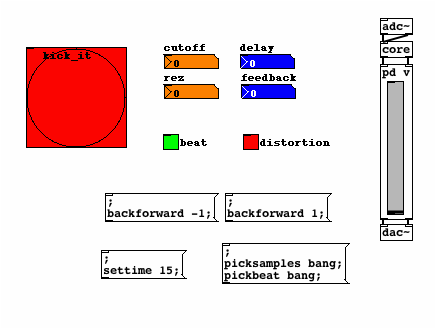
The zipfile under the image above contains a Pure Data patch which procedurally generates a virtually infinite number of acid and breakbeat loops. I've found that it's quite a lot of fun to play with!

Start by loading the patch called 0_START.pd and then turn up the volume and the cutoff. After that hit the big red button a few times until you hear something you like.

I was making it into an RjDj scene, but I am not really sure if I'll ever get around to finishing it.

Garage Acid Lab screenshot

Sept. 13, 2009

update: Oh wow, I completely forgot that there is already an awesome indie game called Dyson, thanks for reminding me, Dan!

Here's another AsteroidsTNG prototype. This asteroid field goes on until MAXFLOAT before looping (I think) and it contains up to 2^32 unique asteroids. I had to remove the collision detection, so you can fly through asteroids, but don't let that stop you from exploring! Oh wow, I just tested this on Internet Explorer and it runs hellishly slow. Sorry IE user, whoever you are. :(
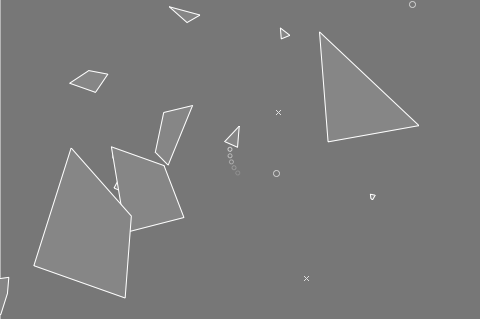
(click on the image to play)

I think if I was ever to turn this into a proper game, I would call it Dyson, after the physicist Freeman Dyson who came up with the concept of the Dyson tree, which I would hope to work into the game. A short time ago I had the great fortune of briefly meeting Freeman Dyson's daughter and tech luminary, Esther Dyson, source of the following great piece of advice:

"Fail cheap. Fail fast. Fail often. Always make new mistakes." -Esther Dyson

I am a huge fan of this philosophy, especially when it comes to rapidly prototyping software and games.

This game was written inside the jsGameSoup framework.

Writing games for javascript and the canvas tag feels a bit like being an eight year old again, trying to squeeze every last cpu cycle out of my parents' Apple //e. Good times!

Sept. 3, 2009

  • Google Android: GNU/Linux
  • Palm Pre OS: GNU/Linux
  • Nokia Maemo: GNU/Linux
  • Amazon Kindle: GNU/Linux
  • Sony Reader: GNU/Linux
  • Crunch Pad (vapour ware): GNU/Linux
  • Apple iPhone: FreeBSD <- :P

Anybody who started tinkering with GNU/Linux just for fun in their teens should initiate smug mode immediately, unless like myself your smug mode is stuck in the on position.

Aug. 8, 2009

One of the practical consequences of using proprietary software is that your right to use that software can be revoked at any time. Recent conflict between Ebay/Skype and the founders of Skype is an illustration of this. Ebay themselves, and millions of Skype users who rely on Skype for their day to day communications with family, business associates, and friends, have put themselves at risk by choosing proprietary software and protocols. Another illustration of this was the music software Logic Pro which alienated its Microsoft Windows user base when Apple bought the product in July 2002, and discontinued the Windows version. Quite apart from events like that, companies often close down, get bought out, go bankrupt, or discontinue a former line of software. This is as true for modern "cloud based" companies like Google as it has always been for companies like Apple and Microsoft. When you invest your time and energy in proprietary software, and software with closed formats, you are disempowering yourself. Free and Open Source Software is, practically speaking, a much safer bet.

July 31, 2009

"You understand and agree that Apple may, in its sole discretion, [...] reject Your Application for distribution for any reason, even if Your Application meets the Documentation and Program Requirements".

-- Apple developer documentation

"The certificate does not need to be signed by a certificate authority: it is perfectly allowable, and typical, for Android applications to use self-signed certificates. The certificate is used only to establish trust relationships between applications, not for wholesale control over whether an application can be installed."

-- Android developer documentation