Oct. 30, 2009

Here are some maddest of props for two great little bits of software we've been using for RjDj work lately, and which might not be that well known yet.

Flot

Flot is a really nice little jQuery library which does exactly what it says on the box: draws charts. It strikes a very nice balance between smart, easy defaults, and being customisable.

http://code.google.com/p/flot/

South

South helps you with database migrations in Django. Database migrations are where you have made your models and deployed them live on the server, including having your SQL tables created, but now you want to change something. People who are used to the flexbility of Python find this situation frustrating. Instead of having to manually write SQL to upgrade your tables to match your new models, South will magically do the hard work for you. What's more is it will have that work represented as Python code which you can customise, modify, and version in your repository. Once again it strikes that balance between doing the right thing and being customisable.

http://south.aeracode.org/

Honorable mention

The rest of our web stack looks like this: Debian GNU/Linux, lighthttpd, python, django, lame, oggdec, postgresql, mysql, wordpress, phpbb3, boto, and we use bzr for versioning.

Together these make as nice and friendly a collection of Free Software as there ever was. Thanks, Free Software makers! You rule.
Oct. 22, 2009

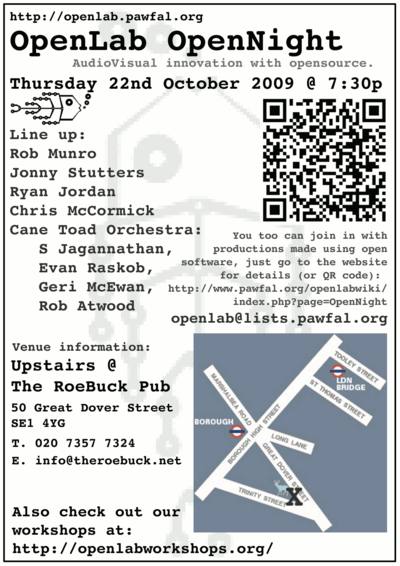
Openlab OpenNight flyer

Thursday 22nd of October, 2009 @ 7:30pm

The Roebuck Pub (SE1 4YG)

  • Rob Munro
  • Jonny Stutters
  • Ryan Jordan
  • Chris McCormick
  • Cane Toad Orchestra

I'm probably going to play a set with my Garage Acid Lab Pd patches, if I can get it together in time.

Oct. 8, 2009

Why doesn't a Google search for "list of laptops which debian runs on" yeild a result which includes this page: Installing Debian On...?

This blog post exists solely to try and rectify that situation.

This article called How to Buy a Laptop for Debian Linux also seems quite informative and is generally the set of steps that I follow when buying a new laptop. One thing that sometimes constrains me is finding a laptop that is aesthetically pleasing and well designed and is also able to run Debian GNU/Linux out of the box. The most important bits of hardware to be sure of running under Debian are usually the video card and the wifi card.

Sept. 29, 2009

Woohoo, Ullrich von Bassewitz has made a new release of everyone's favorite 8bit compiler, cc65 - the first in a while.

cc65 has C and runtime library support for many of the old 6502 machines, including

  • The Commodore VIC20, C16/C116, C64, C128, C116, Plus/4, 510 (aka P500), the 600/700 family and newer PET machines (not 2001).

  • The Apple ][ and successors.

  • The Atari 8 bit machines.

  • GEOS for the C64 and C128.

  • The Nintendo Entertainment System (NES).

  • The Supervision console.

  • The Oric Atmos.

  • The Lynx Console.

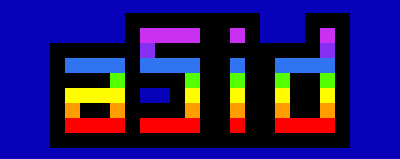
This is the compiler that I used to create aSid, a program which turns your commodore64 into a synthesizer.

Sept. 28, 2009

The Saturday before last was Software Freedom Day, and I'd like to belatedly pay hommage to that weird hippie who many people in the software world seem to hold disdain for, Richard Stallman.

Even if you don't like Stallman's ideas, or his personality, or the way he looks, you are basically 100% 0wned by him.

How can that be? Let me quote from Wikipedia:

"Richard Stallman started GCC in 1985."

BAM! 0wned.

Basically it works like this: Stallman came up with the GNU General Public License, which is like those EULAs that you often have to agree to when installing software, except that it does the opposite to those EULAs in that it guarantees your freedoms as a user of that software rather than restricting them. You interact with thousands of pieces of Free Software on a daily basis, whether you realise it or not, and the GPL is the most widely used Free Software license.

If you have ever used a computer network (e.g. the internet, on which you are reading this), many of the routers through which your traffic travels contain firmware which was compiled using the compiler suite which he created. Likewise if you've ever driven a car, used a games console, television, refrigerator, or a mobile telephone, many of the devices you use would have had their firmware compiled with GCC. In the case of games consoles, pretty much all the games you play on consoles would have been compiled with a GCC variant. So even if the software on those devices is itself not licensed under a Free Software license, you are still using something which was created using a tool created by Stallman. Likewise, if you run any Apple products, or pretty much any OS except a Microsoft OS, a huge amount of the software you interact with on a daily basis was compiled with GCC. I always find it magnificently ironic when I hear or read about people with Macbooks or iPods or iPhones complaining about the GPL and Free Software. Even the firmware in your PC was probably compiled with GCC. Richard Stallman 0wns your computers and your devices.

If you ever use Google, or many of the other high profile internet sites we all interact with on a daily basis, you will often find that those site run GNU/Linux on their servers. The GNU part of GNU/Linux refers to the fact that a large amount of the software in the Linux ecosystem comes from the movement which Richard Stallman started. It's in part due to that movement that we have had the cheap, ubituitous internet experience we have had. Richard Stallman 0wns the internet.

Stallman was right, and as long as you use pretty much any technology at all, you have proved him right.

Free Software has won.